Empowered, Not Perfect
A newsletter for parents raising ADHD and Autistic children
You've read the books.
You've tried strategies.
You've worked with professionals...
Your child may be making progress in important areas.
And yet...
You still find yourself wondering...

What are we missing?
Why did that strategy work yesterday but completely fall apart today?
Why does one transition go smoothly while the next becomes a battle?
Why does your child melt down after winning a game they were so excited to play?
Why are they still struggling with independence in areas you've practiced over and over?
If those questions feel familiar, you're not alone.
One of the hardest parts of parenting an ADHD or Autistic child is that there isn't a single strategy that works in every situation.
The same child may need something different depending on the day, the situation, or what's happening beneath the surface.
Sometimes, the next step isn't another strategy.
Sometimes, it's a different way of looking at the situation.
That's the kind of perspective you'll find in every issue of Empowered, Not Perfect.
Before deciding what might help...
When you're in the middle of a difficult moment, it's natural to start looking for the next strategy to try.
But over the years, I've found that many of the biggest breakthroughs with families didn't begin with a new strategy.
They began by slowing down.
Not necessarily in the middle of the hard moment.
But afterwards.
That's often when we can begin getting curious about what was really happening.
What made this hard for my child?
What could have contributed to this?
What changed?
What have we learned from similar situations before?
Every Tuesday and Thursday, I walk through a real-life situation inspired by the families I've worked with.
Maybe it's a child who refuses to shower
A teenager who comes home from school completely overwhelmed
A child who struggles with disappointment, avoids trying new things, or can't seem to play independently
Or a strategy that worked beautifully one week but suddenly stopped working the next.
Together, we'll slow those moments down and explore what could have been happening beneath the behavior.
Not so you can copy someone else's solution...
But so you can begin making sense of your own family's experiences.
One idea you'll see woven throughout these emails is something I often come back to:
Your child isn't giving you a hard time. They're having a hard time.
It doesn't answer every question...
But it often gives us a better place to begin.
When you start looking beneath the behavior, it's often easier to respond with empathy instead of frustration.
And over time, those moments don't just influence what you try next.
They shape the relationship you're building with your child.
What readers are saying:

"I am LOVING this newsletter! You’re definitely on to something with this. There are so many parents who would benefit."
- S
"I absolutely LOVE reading your newsletter and this one arrives at the perfect time because I’ve been having a lot of the “pushing/boundary and sensory seeking” lately and, with extended family around us that holds rather old fashioned views, it’s really hard for me to parent right now."
- P.T.
"This newsletter rocks. I read it and learn and I am far past raising children stage, but use some of this with my granddaughter for sure"
- Jacob R.
"I always look forward to your newsletter. It's a bright spot in my week. I always learn something or am reminded why something does or doesn't work. Your focus on the true source of behavior has helped me feel more connected to my son. We can joke around, laugh, and be loving. There are still challenges, but I feel more equipped to deal with them."
- Helen M.
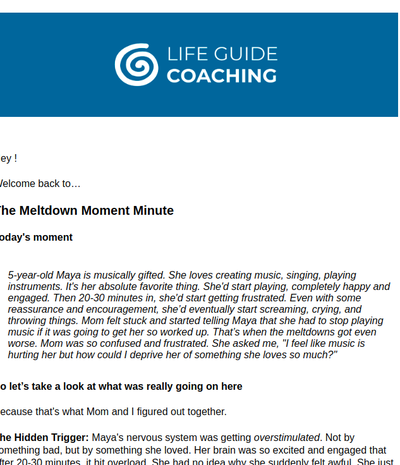
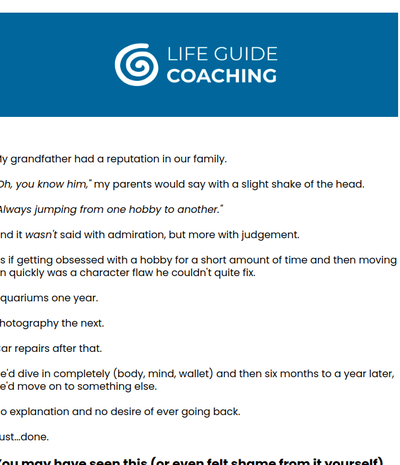
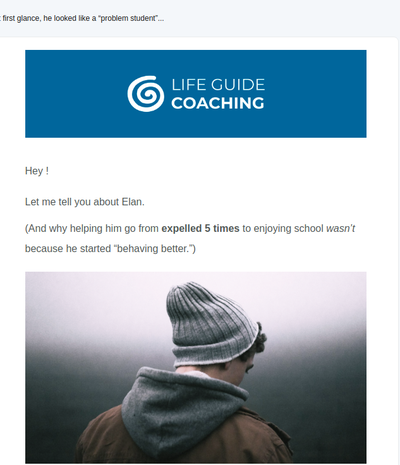
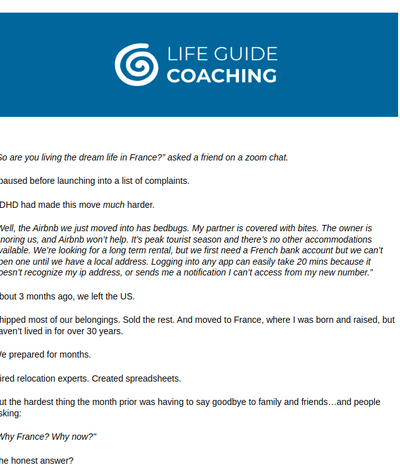
Curious what the newsletter is like?
Here are a few recent issues to give you a feel for what you can expect.
Why I write these emails
For more than 30 years, I've supported neurodivergent children, teens, adults, and their families—first as an Occupational Therapist, and now as a parent coach.
I'm also neurodivergent myself and grew up in a neurodiverse family.
Those experiences have shaped the questions I ask, the way I approach challenging situations, and the conversations I have with families every day.
Over the years, I've learned that the same strategy can help one child, but not another.
It can even work beautifully for the same child one day and completely fall apart the next.
That's why I spend less time asking, "What's the right strategy?"
And more time asking, "What's getting in the way?"
That's the approach I use in my coaching.
And it's the approach I hope to share with you every Tuesday and Thursday through this newsletter.
If these emails do one thing, I hope they help you leave difficult moments with a little more curiosity and a little less self-blame.

Join me every Tuesday and Thursday.
If you're ready for more than another list of parenting tips...
If you'd like a chance to slow down, make sense of situations that don't seem to make sense, and practice a different way of approaching everyday parenting challenges...
I'd love to have you join me.



© 2025 Christian Vinceneux. All rights reserved
